

Your throat suddenly hurts when you swallow. Maybe you also have a fever, swollen glands, or white spots on your tonsils.
The first question that often comes to mind is:
Is this just a sore throat, or do I have strep throat?
Understanding strep throat vs sore throat matters because they are not the same thing. A sore throat is a symptom that can have many causes. Strep throat is a specific bacterial infection caused by group A Streptococcus bacteria.
Most sore throats are caused by viruses and improve without antibiotics. Strep throat, however, should be properly diagnosed because confirmed infections are treated with antibiotics to shorten symptoms, reduce transmission, and decrease the risk of complications.
At Crabapple Medical Center in Alpharetta, GA, our healthcare providers can evaluate sore throat symptoms and help determine when testing or medical treatment is appropriate.
What Is a Sore Throat?
A sore throat, medically called pharyngitis, refers to pain, irritation, scratchiness, or inflammation in the throat.
It is a symptom rather than a single disease.
Many different conditions can cause your throat to hurt, including:
- Common cold viruses
- Influenza
- COVID-19
- Other respiratory viruses
- Strep throat
- Allergies
- Postnasal drip
- Dry air
- Acid reflux
- Smoke or other environmental irritants
Viruses are the most common cause of acute pharyngitis across all age groups.
This means that having a sore throat does not automatically mean that you need antibiotics or even a strep test.
The surrounding symptoms often provide important clues.
What Is Strep Throat?
Strep throat is a bacterial infection of the throat and tonsils caused by Streptococcus pyogenes, also known as group A Streptococcus or group A strep.
Anyone can develop strep throat, but it occurs most frequently in children between 5 and 15 years old. Adults who spend significant time around school-age children may also have increased exposure.
Strep throat can spread through respiratory droplets and close contact.
The incubation period is generally about two to five days, meaning symptoms may develop several days after exposure.
Unlike a typical viral sore throat, confirmed strep throat is treated with antibiotics.
Strep Throat vs Sore Throat: The Biggest Difference
| Symptom | Strep Throat | Viral Sore Throat |
|---|---|---|
| Sudden sore throat | Common | Possible |
| Pain when swallowing | Common | Common |
| Fever | Common | Possible |
| Swollen neck lymph nodes | Common | Possible |
| Red, swollen tonsils | Common | Common |
| White patches on tonsils | Can occur | Can sometimes occur |
| Tiny red spots on roof of mouth | Can occur | Less typical |
| Cough | Usually absent | Common |
| Runny nose | Usually absent | Common |
| Hoarse voice | Usually absent | Common |
| Conjunctivitis or red eyes | Usually absent | Can occur |
| Oral ulcers | Usually absent | Can occur |
| Headache | Possible | Possible |
| Nausea or stomach pain | Can occur, especially in children | Possible |
These signs can increase or decrease suspicion for strep, but symptoms alone cannot always reliably distinguish a bacterial infection from a viral infection.
Symptoms That Suggest Strep Throat
Strep throat often begins relatively suddenly.
According to the CDC, common symptoms include:
- Sudden sore throat
- Pain when swallowing
- Fever
- Red and swollen throat or tonsils
- Tender lymph nodes in the front of the neck
- White patches or pus on the tonsils
- Tiny red spots on the roof of the mouth
Some people can also develop a red, rough-feeling rash associated with scarlet fever.
Children may experience additional symptoms such as headache, stomach pain, nausea, or vomiting.
One particularly helpful clue is what is not present.
People with classic strep throat typically do not have cough, runny nose, hoarseness, oral ulcers, or conjunctivitis.
Symptoms That Suggest a Viral Sore Throat
A sore throat is more likely to be caused by a virus when it appears alongside classic cold or respiratory symptoms.
These may include:
- Cough
- Runny or stuffy nose
- Sneezing
- Hoarse voice
- Red or watery eyes
- Oral ulcers
The CDC specifically identifies cough, rhinorrhea, hoarseness, oral ulcers, and conjunctivitis as symptoms that strongly suggest a viral infection rather than group A strep.
For example, if your sore throat develops alongside congestion, sneezing, and a persistent cough, a viral respiratory infection may be more likely than strep throat.
Crabapple Medical Center's flu guidance also notes that influenza can cause sore throat along with fever, cough, congestion, body aches, headache, and significant fatigue.
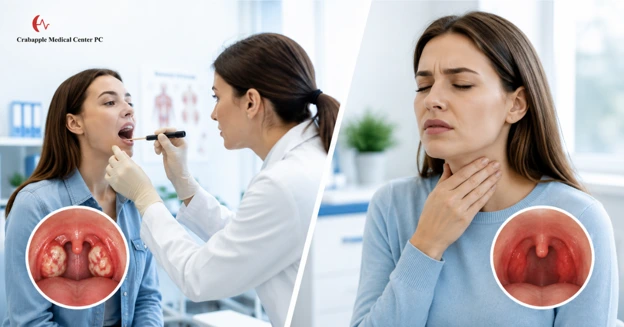
Can You Tell Strep Throat by Looking at Your Tonsils?
Not reliably.
Many people associate strep throat with white spots on the tonsils. While tonsillar exudate can occur with strep, white patches are not proof that group A strep bacteria are responsible.
Other infections can cause tonsil swelling, redness, or white material.
Similarly, a throat without white patches does not automatically rule out strep.
When obvious viral symptoms are absent, the CDC notes that healthcare providers cannot reliably distinguish viral pharyngitis from group A strep based only on examination. Testing is needed to confirm the diagnosis when strep is suspected.
This is why searching online for pictures of "what strep throat looks like" is not a substitute for appropriate testing.
Does Strep Throat Always Cause a Fever?
No.
Fever is common with strep throat, but not every patient will have every classic symptom.
You may still require evaluation if you have significant throat pain, swollen lymph nodes, known strep exposure, tonsil inflammation, or other concerning symptoms even if your temperature is normal.
The same principle works in reverse.
Having a fever does not prove that you have strep throat. Influenza, COVID-19, and many other viral infections can also cause fever and sore throat.
Your complete symptom pattern and, when appropriate, testing provide a more reliable answer.
Does Strep Throat Cause a Cough?
A cough makes classic strep throat less likely.
According to CDC guidance, patients with group A strep pharyngitis typically do not have a cough.
A sore throat combined with cough, runny nose, and hoarseness is more suggestive of a viral respiratory infection.
However, medicine rarely works in absolutes. Symptoms can overlap, and having a cough does not make bacterial infection impossible.
A healthcare provider can assess the entire clinical picture rather than relying on one symptom.
How Common Is Strep Compared With a Regular Sore Throat?
Most sore throats are not strep throat.
The CDC estimates that group A strep causes approximately:
20% to 30% of sore throat episodes in children
and
5% to 15% of sore throat infections in adults.
Put another way, most adults with a sore throat have another cause, commonly a virus.
This is one reason antibiotics should not automatically be prescribed whenever someone develops throat pain.
Who Is Most Likely to Get Strep Throat?
Strep throat is especially common among children between ages 5 and 15.
Close contact is another major risk factor.
Exposure may occur in:
Schools, daycare centers, households, workplaces involving frequent contact with children, and other settings where people spend extended periods together.
Parents of school-age children and adults who regularly work with children may therefore have greater exposure to group A strep bacteria.
Strep throat is relatively uncommon in children younger than 3 years old.
When Should You Get Tested for Strep Throat?

You do not necessarily need a strep test every time your throat hurts.
Clear viral symptoms can make strep testing unnecessary.
For example, when sore throat occurs together with obvious cough, runny nose, hoarseness, or conjunctivitis, a clinician may be able to identify a likely viral infection without testing for group A strep.
Testing becomes more relevant when symptoms are consistent with strep and there are no clear viral symptoms.
Signs that may prompt a healthcare provider to consider testing include:
Sudden significant sore throat, fever, painful swallowing, swollen or tender lymph nodes in the front of the neck, inflamed tonsils, tonsillar exudate, or known exposure to someone diagnosed with strep throat.
Updated 2025 Infectious Diseases Society of America guidance also suggests that clinicians use a validated clinical scoring system to help determine which children and adults with sore throat are most likely to benefit from group A strep testing.
Clinical scoring helps guide the decision to test. It does not replace the diagnostic test itself when confirmation is needed.
What Is a Rapid Strep Test?
A rapid strep test is one of the most common ways healthcare providers check for group A Streptococcus.
During the test, a healthcare professional uses a swab to collect a sample from the back of your throat and tonsil area.
The sample is then tested for evidence of group A strep bacteria.
Rapid antigen detection tests can provide results much faster than traditional throat cultures.
A positive rapid strep test can confirm group A strep pharyngitis in a patient with compatible symptoms.
A negative test requires slightly different considerations depending on the patient's age.
What Happens If the Rapid Strep Test Is Negative?
Rapid strep tests are highly specific, but they can occasionally miss infections.
For symptomatic children aged 3 years and older, CDC guidance recommends confirming a negative rapid antigen test with a throat culture.
For adults, a backup throat culture after a negative rapid strep test is generally not routinely necessary because acute rheumatic fever is very rare in adults.
Your healthcare provider will determine whether additional testing is appropriate based on age, symptoms, exposure, risk factors, and the type of test performed.
What Is a Throat Culture?
A throat culture starts with the same basic process as a rapid test.
A swab is taken from the throat and then sent for laboratory evaluation to see whether group A strep bacteria grow from the sample.
Results take longer than a rapid test, but throat culture remains the traditional gold standard diagnostic method and can sometimes identify infections that rapid antigen tests miss.
This is why throat culture is particularly useful as confirmation after certain negative rapid tests in children.
Can You Diagnose Strep Throat Without a Test?
Symptoms can indicate how likely strep is, but they generally cannot confirm it when obvious viral symptoms are absent.
A severe sore throat, fever, swollen lymph nodes, and white patches may strongly suggest strep. Those same findings, however, can occur with other infections.
The current IDSA guideline recommends using clinical scoring systems to identify patients who should be tested rather than relying on clinician judgment alone.
Testing helps avoid two problems:
Treating viral infections unnecessarily with antibiotics and missing genuine strep infections that would benefit from treatment.
Do You Need Antibiotics for a Sore Throat?
Usually not.
Antibiotics kill bacteria. They do not treat viruses.
Because most sore throats are viral, antibiotics will not make most sore throats resolve faster.
CDC guidance states specifically that viral pharyngitis should not be treated with antibiotics. Patients with a confirmed positive rapid strep test or throat culture should receive antibiotic treatment.
Avoid taking leftover antibiotics or antibiotics prescribed for another person.
Using antibiotics when they are not medically necessary can expose you to unwanted side effects and contribute to the broader problem of antibiotic resistance.
How Is Confirmed Strep Throat Treated?

Confirmed group A strep throat is treated with antibiotics.
Penicillin and amoxicillin remain the preferred first-line treatments for many patients. Alternative medications may be used when someone has certain penicillin allergies or other medical considerations.
The correct medication, dose, and treatment duration depend on factors including age, weight, allergy history, and medical condition.
Antibiotic treatment for confirmed strep throat can:
Shorten symptoms, reduce transmission to other people, and lower the likelihood of complications.
If antibiotics are prescribed, take them exactly as directed by your healthcare provider.
How Long Is Strep Throat Contagious?
Group A strep spreads easily through close contact and respiratory droplets.
Appropriate antibiotic treatment significantly reduces the ability to transmit the bacteria.
The CDC recommends that people with strep throat stay home from work, school, or daycare until they are no longer feverish and have received appropriate antibiotics for at least 12 to 24 hours.
Your healthcare provider can give you specific return-to-school or return-to-work guidance.
Good hand hygiene and respiratory etiquette can also help reduce transmission.
Is a Viral Sore Throat Contagious?
A sore throat itself is a symptom, so whether it is contagious depends on what caused it.
If a viral respiratory infection causes your sore throat, the underlying virus can often spread to other people.
This is why it is helpful to consider your complete illness rather than viewing throat pain as an isolated symptom.
Frequent handwashing, covering coughs and sneezes, avoiding sharing drinks or utensils, and limiting close contact when sick can help reduce the spread of respiratory infections.
Strep Throat vs Tonsillitis: Are They the Same?
Not exactly.
Tonsillitis means the tonsils are inflamed.
Viruses can cause tonsillitis, and bacteria can cause it as well.
Strep throat is one possible bacterial cause of tonsil inflammation.
Therefore:
Strep throat can cause tonsillitis, but not every case of tonsillitis is strep throat.
This distinction matters because viral tonsillitis does not benefit from antibiotics, while confirmed group A strep infection does.
Can Strep Throat Go Away Without Antibiotics?
Symptoms of strep throat can eventually improve even without treatment in some people, but that does not mean confirmed strep should be ignored.
Antibiotics are recommended for confirmed group A strep because treatment shortens symptoms, decreases transmission, and reduces complications.
One of the most important reasons to diagnose strep correctly is to prevent avoidable complications, particularly in children.
What Can Happen If Strep Throat Is Not Treated?
Most cases of strep throat are uncomplicated, particularly when appropriately diagnosed and treated.
Rare complications can occur when infection spreads or triggers an immune response.
Potential complications include:
- Peritonsillar abscess
- Retropharyngeal abscess
- Cervical lymph node infection
- Acute rheumatic fever
- Post-streptococcal glomerulonephritis
The CDC notes that certain complications are more likely after an untreated infection.
This does not mean every untreated sore throat will lead to complications. It means that confirmed bacterial strep infection should be taken seriously.
What Is Scarlet Fever?
Some people with group A strep infection develop scarlet fever.
In addition to sore throat and fever, scarlet fever can cause a red rash that often feels rough or sandpaper-like.
A rash associated with sore throat and fever deserves medical evaluation, particularly in children.
Testing can determine whether group A strep is responsible, and confirmed infections are treated with antibiotics.
Can Adults Get Strep Throat?
Yes.
Strep throat is more common in children, but adults can certainly develop it.
Parents, teachers, childcare workers, healthcare workers, and other adults who frequently interact with children may be at increased risk because close contact with an infected person is an important risk factor.
However, only approximately 5% to 15% of adult pharyngitis cases are caused by group A strep.
For this reason, adults should not assume every severe sore throat requires antibiotics.
Can You Have Strep Throat Without White Spots?
Yes.
White patches on the tonsils can occur with strep throat, but they are not required for the diagnosis.
A person may have group A strep infection without obvious white spots.
Likewise, white patches can occur with illnesses other than strep.
Testing, rather than tonsil appearance alone, provides a more dependable diagnosis when strep is suspected.
Can You Have Strep Without a Sore Throat?
Some people can carry group A strep bacteria in their throat without being sick.
These individuals are known as strep carriers.
According to the CDC, carriers generally do not need antibiotics. They are less likely to spread the bacteria and are at very low risk of developing complications.
This can occasionally make testing complicated.
A carrier who develops an unrelated viral sore throat could still test positive for group A strep even though the virus is causing the current symptoms.
A healthcare provider considers symptoms and clinical history when interpreting test results.
How to Manage a Viral Sore Throat at Home
For uncomplicated viral sore throats, treatment is usually focused on comfort while your immune system clears the infection.
Helpful measures may include drinking plenty of fluids, resting, gargling warm salt water, using warm beverages or broth, using a cool-mist humidifier, and avoiding cigarette smoke or other throat irritants.
Over-the-counter pain and fever medicines may also be appropriate for some people. Follow medication labels and talk with your healthcare provider if you have medical conditions, take other medications, are pregnant, or are unsure which medicine is safe for you.
Crabapple Medical Center's flu guidance similarly recommends hydration, rest, salt-water gargles, and humidified air for respiratory illnesses that include throat discomfort.
When Should You See a Doctor for a Sore Throat?
Consider medical evaluation when your sore throat is severe, develops suddenly with fever, makes swallowing significantly painful, is accompanied by swollen neck glands, occurs after known strep exposure, or is associated with a rash.
You should also seek evaluation when symptoms are getting worse rather than improving or when they persist longer than expected.
For children, particularly school-age children with classic strep symptoms, timely evaluation can determine whether testing is appropriate.
If you have already been diagnosed with strep and are not improving after about 48 hours of antibiotics, contact your healthcare provider. The CDC specifically recommends follow-up when symptoms do not improve after 48 hours of treatment.
When Is a Sore Throat an Emergency?
Most sore throats are not emergencies.
However, seek urgent or emergency medical attention for symptoms such as:
- Difficulty breathing
- Inability to swallow liquids
- Drooling because swallowing is difficult
- Significant swelling of the throat or neck
- Severe dehydration
- Confusion or extreme weakness
- Rapidly worsening symptoms
- Signs of a serious allergic reaction
Severe one-sided throat pain, a muffled voice, difficulty opening the mouth, or pronounced neck swelling may also require prompt evaluation because complications such as a deep throat abscess can occasionally occur.
Do not wait for a routine office appointment if breathing or swallowing is seriously impaired.
Strep Throat vs Sore Throat in Children
Parents often have the greatest difficulty deciding whether a child's sore throat requires testing.
A child with sore throat plus cough, runny nose, and hoarseness is more likely to have a viral infection.
A school-age child with sudden throat pain, fever, painful swallowing, swollen front neck glands, and no cough may raise greater suspicion for strep.
Children can also experience stomach pain, nausea, vomiting, or headache with group A strep infection.
When a rapid antigen test is negative in a symptomatic child age 3 or older, current CDC guidance recommends a follow-up throat culture to make sure group A strep was not missed.
Should Everyone in the Family Get Tested If One Person Has Strep?
Not automatically.
Close household exposure increases the risk of infection, but testing decisions are generally based on symptoms and individual risk.
The 2025 IDSA update notes that household exposure is an important factor clinicians may consider when evaluating a patient with sore throat.
If someone in your household has confirmed strep and you develop compatible symptoms, tell your healthcare provider about the exposure.
How Can You Prevent Strep Throat From Spreading?
Simple infection-control habits can reduce transmission.
Wash your hands regularly with soap and water, especially after coughing or sneezing and before preparing food.
Avoid sharing cups, utensils, water bottles, or food with someone who is sick.
Cover coughs and sneezes appropriately.
Someone diagnosed with strep should remain home until fever has resolved and appropriate antibiotic treatment has been taken for at least 12 to 24 hours.
These habits are particularly important in households with children, schools, and other close-contact settings.
Why Testing Is Better Than Guessing
The comparison of strep throat vs sore throat can seem straightforward when you look at a list of symptoms.
Real patients do not always follow textbook patterns.
A viral infection can cause a very painful throat.
Strep can occur without white patches.
Not everyone with strep has a high fever.
And symptoms such as fever, swollen tonsils, and painful swallowing can occur with several illnesses.
That is why appropriate testing is valuable.
A strep test can help your healthcare provider avoid unnecessary antibiotics when a virus is responsible while ensuring that confirmed bacterial infections receive appropriate treatment.
Sore Throat Care at Crabapple Medical Center in Alpharetta, GA
If your throat hurts and you are unsure whether you have a viral illness or strep throat, Crabapple Medical Center can help you determine the appropriate next step.
Our providers can review your symptoms, examine your throat, consider recent exposures and risk factors, and determine whether diagnostic testing or treatment is appropriate.
Crabapple Medical Center also provides walk-in care for non-emergency medical needs and accommodates same-day appointments whenever possible, making it easier to receive timely evaluation when an illness develops unexpectedly.
If you are experiencing a severe sore throat, fever, painful swallowing, swollen glands, or possible strep exposure, seeking an evaluation can provide a more reliable answer than trying to diagnose yourself from symptoms alone.
Do Not Assume Every Sore Throat Is Strep
The most important thing to remember about strep throat vs sore throat is that a sore throat describes a symptom while strep throat describes a specific bacterial infection.
Most sore throats are viral.
Symptoms such as cough, runny nose, hoarseness, and red eyes make a viral cause more likely. Sudden throat pain, fever, tender neck glands, tonsil inflammation, and the absence of cough may increase suspicion for strep.
But symptoms alone cannot always provide a definitive answer.
If your symptoms suggest strep throat, proper testing can confirm whether group A Streptococcus is responsible and whether antibiotics are needed.
Sore Throat That Will Not Go Away?
Whether it is you or your child, a persistent sore throat is worth checking. Our team at Crabapple Medical Center in Alpharetta, GA identifies the cause and recommends the right treatment, from strep testing to relief that actually works.
Frequently Asked Questions
What is the main difference between strep throat and a regular sore throat?
A sore throat is a symptom that can be caused by many conditions, especially viral infections. Strep throat is a specific bacterial infection caused by group A Streptococcus. Most sore throats are viral rather than strep.
How can I tell if my sore throat is strep?
Symptoms that increase suspicion for strep include sudden throat pain, fever, painful swallowing, tender lymph nodes in the front of the neck, inflamed tonsils, and absence of cough. However, symptoms alone cannot reliably confirm strep in many cases. A rapid strep test or throat culture may be needed.
Does coughing mean I do not have strep throat?
Cough is not typical of classic group A strep throat and makes a viral cause more likely, especially when accompanied by runny nose or hoarseness. It does not provide a perfect diagnosis by itself.
Can strep throat occur without a fever?
Yes. Fever is common, but not every patient experiences every classic symptom. If other signs are concerning strep, a healthcare provider can determine whether testing is appropriate.
Can strep throat occur without white spots?
Yes. White patches or tonsillar exudate may occur with strep throat, but they are not required. Likewise, white spots do not prove that someone has strep because other infections can produce similar findings.