
You wake up with a throbbing ear, a fever that will not break, or a sore throat so painful you can barely swallow. Your first instinct might be to head straight to the emergency room. But in most cases, that is not the right move. Emergency rooms are designed for life-threatening situations, and using them for everyday illnesses means longer waits, significantly higher bills, and the same treatment you could have received at a walk-in clinic in a fraction of the time.
The truth is that the vast majority of conditions that feel urgent are not actually emergencies. They are treatable, manageable, and best handled at a walk-in primary care clinic where real physicians evaluate and treat you efficiently without the chaos and cost of an ER setting.
At Crabapple Medical Center in Alpharetta, Georgia, walk-in services are available for patients who need care today without the wait. This guide covers the most common conditions treated at a walk-in clinic, what you should actually go to the ER for, and why choosing walk-in care first is almost always the smarter, more affordable decision.
The Real Cost of Choosing the ER Unnecessarily
Before diving into conditions, it is worth understanding just how expensive the wrong choice can be. The average ER visit in the United States costs between $1,000 and $3,000 for a non-emergency condition. That bill often includes a facility fee, physician fee, and charges for any testing done, all billed separately. Even with insurance, the out-of-pocket costs can be significant. Without insurance, the numbers can be staggering.
A walk-in visit at Crabapple Medical Center, by contrast, starts at just $100 for established patients and $200 for new patients. In-house testing such as a rapid strep test runs $30, a COVID and flu combo test is $50, and an EKG is $40. The entire cost of your walk-in visit, including the exam and relevant testing, is often less than the ER facility fee alone.
Beyond the financial difference, walk-in clinics typically have far shorter wait times for non-emergency concerns. You are seen by a physician, receive a diagnosis, and leave with a treatment plan without spending hours in a waiting room surrounded by patients with far more serious conditions.
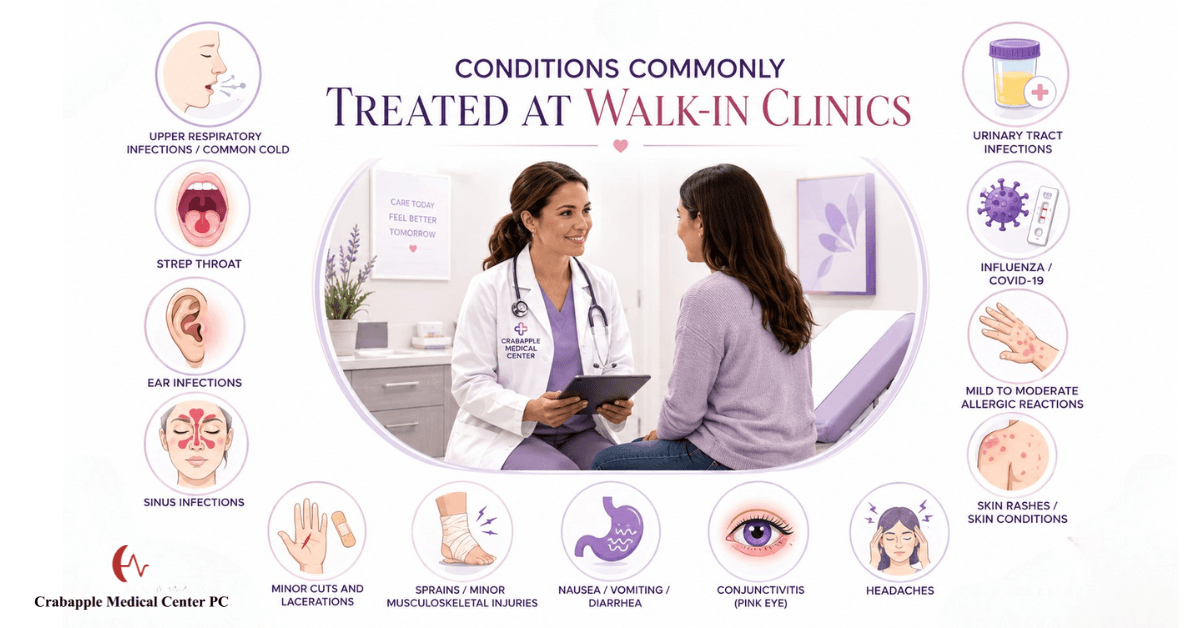
Conditions Commonly Treated at Walk-In Clinics
Upper Respiratory Infections
Upper respiratory infections, commonly known as the common cold, are among the most frequent reasons people visit a walk-in clinic. Symptoms include a runny nose, mild sore throat, congestion, cough, and low-grade fever. While most viral respiratory infections resolve on their own, a physician can determine whether bacterial involvement is present, recommend appropriate medications, and rule out a more serious lower respiratory condition such as bronchitis or pneumonia.
Strep Throat
Strep throat is a bacterial infection caused by Group A Streptococcus that requires a specific test to diagnose and antibiotics to treat properly. It does not resolve on its own and can lead to complications such as rheumatic fever if left untreated. Crabapple Medical Center offers rapid strep testing on site, with results in minutes. If your test is positive, your physician can prescribe antibiotics during the same visit.
Ear Infections
Ear infections, or otitis media, are painful conditions that affect both children and adults. Symptoms include ear pain, a sense of fullness in the ear, muffled hearing, and sometimes fever or drainage. A physician can examine the ear directly, confirm the diagnosis, and prescribe antibiotic treatment when appropriate. There is no reason to sit in an emergency room for an ear infection when walk-in care can handle it far more efficiently.
Sinus Infections
A sinus infection, or sinusitis, occurs when the sinus cavities become inflamed and blocked, usually following a cold or allergic flare. Symptoms include facial pressure, nasal congestion, thick discolored nasal discharge, headache, and sometimes fever. Chronic or bacterial sinus infections often benefit from antibiotic treatment. A walk-in physician can assess your symptoms, determine whether antibiotics are appropriate, and provide treatment that helps you recover faster.
Urinary Tract Infections
Urinary tract infections, commonly called UTIs, cause burning during urination, frequent urges to urinate, cloudy or strong-smelling urine, and pelvic discomfort. They are extremely common, particularly among women, and require antibiotic treatment to clear. CMC can perform a urinalysis on site to confirm the infection and prescribe the appropriate antibiotic without delay. Left untreated, a UTI can progress to a kidney infection, which is significantly more serious.
Influenza and COVID-19
Flu and COVID-19 share many overlapping symptoms including fever, body aches, fatigue, sore throat, and respiratory symptoms. Knowing which one you have matters because treatments differ. Crabapple Medical Center offers a combined COVID and flu rapid test, giving you a clear answer quickly. If treatment is appropriate, such as antivirals for flu or COVID, your physician can prescribe them during the same visit when started early in the illness.
Mild to Moderate Allergic Reactions
Allergic reactions that cause hives, rash, itching, mild swelling, or sneezing and watery eyes can be effectively treated at a walk-in clinic. Antihistamines, corticosteroids, and other medications can be administered or prescribed based on the severity of your reaction. CMC offers on-site injections including Solumedrol and Decadron for more significant allergic responses. Severe allergic reactions involving throat swelling, difficulty breathing, or loss of consciousness require emergency care immediately.
Skin Rashes and Conditions
Many skin conditions are best evaluated in person by a physician who can examine the affected area directly. Common skin concerns treated at walk-in clinics include contact dermatitis, eczema flares, minor wound infections, impetigo, shingles in its early stages, and fungal infections. A physician can determine whether a topical treatment, oral medication, or further evaluation is needed and send you home with a clear treatment plan.
Minor Cuts and Lacerations
Not every cut requires an emergency room. Lacerations that are small, clean, and not actively spurting blood can often be treated at a walk-in clinic with wound cleaning, closure with steri-strips or sutures if needed, and appropriate wound care instructions. A physician can also assess tetanus vaccination status and administer a booster if necessary.
Sprains and Minor Musculoskeletal Injuries
Ankle sprains, muscle strains, and minor joint injuries are among the most common reasons people consider an ER visit unnecessarily. Walk-in clinics can evaluate the injury, determine whether imaging is needed, and provide guidance on rest, ice, compression, and elevation. If a fracture is suspected, CMC can refer you appropriately, but many sprains can be managed entirely through walk-in care.
Nausea, Vomiting, and Diarrhea
Gastrointestinal illness can be miserable but is rarely an emergency when symptoms are moderate. A physician can assess your hydration status, rule out more serious causes, and prescribe anti-nausea medication or other supportive treatment. If dehydration is a concern, a nebulizer or injection treatment may be administered on site. Severe or prolonged gastrointestinal symptoms with blood or signs of significant dehydration warrant further evaluation.
Conjunctivitis (Pink Eye)
Pink eye, whether viral or bacterial, causes redness, discharge, and irritation in one or both eyes. Bacterial conjunctivitis responds well to antibiotic eye drops, which require a prescription. A physician can differentiate between viral and bacterial conjunctivitis and recommend the appropriate treatment to help you heal faster and prevent spreading the infection.
Headaches
Most headaches, including tension headaches and migraine episodes in patients with a known migraine history, can be evaluated and treated at a walk-in clinic. A physician can assess the nature of your headache, rule out concerning features that would require emergency evaluation, and recommend or prescribe appropriate pain relief or migraine medication. Sudden severe headaches described as the worst headache of your life, or headaches accompanied by neurological symptoms, require immediate emergency evaluation.
Blood Pressure Checks and Prescription Refills
Many patients with chronic conditions such as hypertension or diabetes need periodic blood pressure monitoring or bridge prescriptions when their regular doctor is unavailable. Walk-in clinics can handle these straightforward needs quickly so you do not experience a gap in care.
Walk In and Get Seen Today
When something feels wrong and you need answers today, Crabapple Medical Center is ready. Our walk-in services provide real physician care for a wide range of non-emergency conditions without the long waits or high costs of an emergency room.
When You Should Go to the Emergency Room
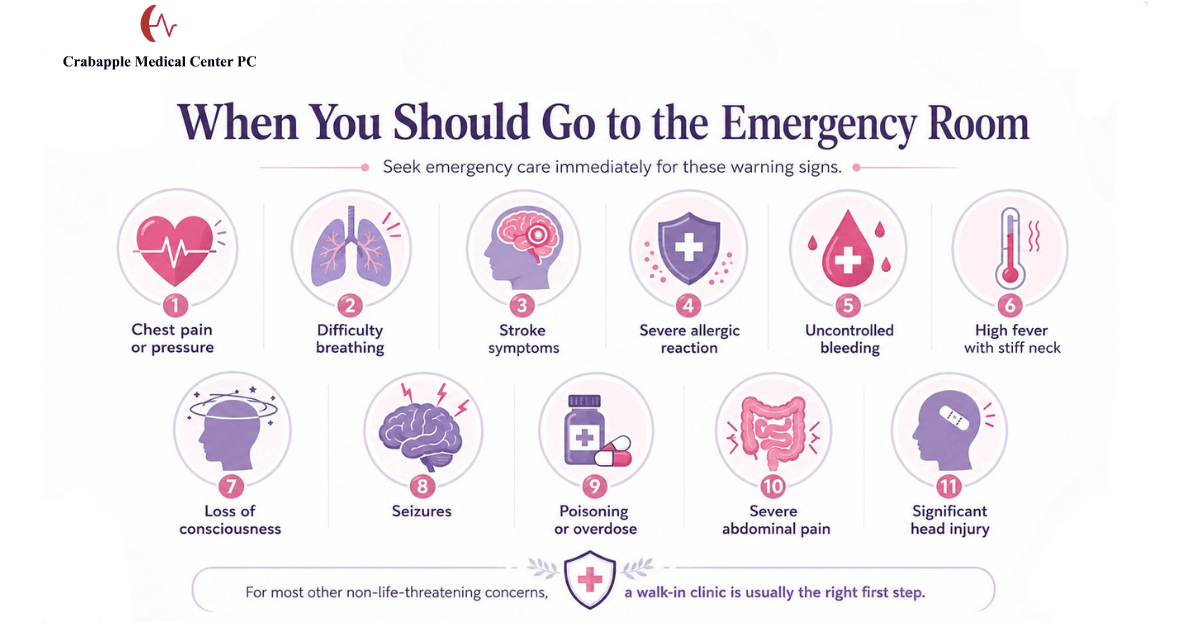
Knowing when not to go to the ER is important, but knowing when you absolutely must is equally critical. Go directly to the emergency room for the following situations.
Chest pain or pressure, especially with arm pain, jaw pain, or sweating. Difficulty breathing or severe shortness of breath. Signs of stroke including sudden facial drooping, arm weakness, or difficulty speaking. Severe allergic reactions with throat swelling or loss of consciousness. Uncontrolled bleeding. High fever with a stiff neck. Loss of consciousness. Seizures. Suspected poisoning or overdose. Severe abdominal pain. Significant head injuries.
For everything else, a walk-in clinic is almost certainly the right first call.
What to Expect When You Walk Into Crabapple Medical Center
CMC's walk-in services are designed for patients who need medical attention today without a prescheduled appointment. When you arrive, you will be greeted by friendly front desk staff who will collect your basic information and reason for the visit. You will be seen by a physician, not a nurse practitioner or physician assistant, ensuring a higher level of evaluation and decision-making.
Depending on your condition, in-house tests such as a rapid strep test, COVID and flu combo, urinalysis, or EKG may be performed during your visit. If lab work beyond what CMC provides on site is needed, a referral will be placed with a nearby lab.
All pricing is transparent and available at crabapplemc.com/self-pay-prices. Self-pay patients are always welcome, and there are no hidden fees or surprise bills. You know what your visit costs before you leave.
Affordable Walk-In Care for Insured and Self-Pay Patients
Whether you have insurance or are paying out of pocket, Crabapple Medical Center offers transparent, affordable walk-in care with no surprises. Established patient visits start at just $100 and in-house testing is competitively priced.
Frequently Asked Questions
What is the difference between a walk-in clinic and an urgent care center?
Walk-in clinics and urgent care centers both treat non-emergency conditions without appointments, but a key difference is the level of physician involvement. At Crabapple Medical Center, patients are seen by a physician rather than being limited to nurse practitioners or physician assistants. This means a higher standard of evaluation, especially for patients with complex histories or multiple symptoms.
Can a walk-in clinic prescribe medications?
Yes. Physicians at Crabapple Medical Center can diagnose your condition and prescribe appropriate medications during your visit, including antibiotics, antivirals, anti-nausea medications, and more. Prescriptions are sent electronically to your preferred pharmacy.
What should I bring to a walk-in visit?
Bring a valid photo ID, your insurance card if you have one, a list of current medications and dosages, and information about any relevant medical history. Self-pay patients do not need insurance documentation but may want to review pricing at crabapplemc.com/self-pay-prices before arriving.
How long will I wait at a walk-in clinic compared to an ER?
Walk-in clinics typically have significantly shorter wait times than emergency rooms for non-emergency conditions. ER wait times for non-critical patients can range from two to six hours or more depending on volume. At a walk-in clinic focused on non-emergency care, most patients are seen much more quickly.
What if my condition turns out to be more serious than expected?
If the physician at CMC determines that your condition requires emergency evaluation or hospitalization, you will be advised to go to the nearest emergency room and given documentation of your visit and findings to take with you. Patient safety is always the first priority.
Can I use a walk-in clinic for ongoing care or just one-time visits?
Absolutely. Many patients who start with a walk-in visit at Crabapple Medical Center choose to establish CMC as their primary care home. The practice offers full primary care services including annual physicals, chronic disease management, women's health, and more. Your walk-in visit can be the beginning of a long-term relationship with a physician who knows your health history.