

If you are a pilot in the United States, maintaining your medical certificate is not optional. The Federal Aviation Administration requires all pilots to meet specific health standards before they are cleared to fly, and those standards are verified through a visit to a designated Aviation Medical Examiner, more commonly known as an AME.
This guide covers everything you need to know about the FAA aviation medical exam, from how to prepare before your appointment to what the examiner is evaluating during each part of the visit, what conditions may raise a concern, and what your options are if you do not meet standard requirements.
Crabapple Medical Center in Alpharetta, Georgia is an FAA-certified facility offering Class 2 and Class 3 flight physicals as well as BasicMed evaluations. If you are a pilot in the North Atlanta area looking for an experienced and thorough AME, Crabapple Medical Center is ready to help you stay cleared for takeoff.
Understanding the Classes of FAA Medical Certificates

Before diving into the exam itself, it helps to understand what type of medical certificate you need and how that affects the scope of the evaluation.
Third Class Medical Certificate
The Third Class certificate is required for student pilots, private pilots, and recreational pilots. It is the least restrictive of the traditional FAA certificates. For pilots under age 40, a Third Class certificate is valid for 60 months. For pilots age 40 and older, it is valid for 24 months. Crabapple Medical Center offers Class 3 physicals for pilots in this category.
Second Class Medical Certificate
The Second Class certificate is required for commercial pilots who are paid to carry passengers or cargo, as well as flight instructors who receive compensation for providing instruction.
This certificate is valid for 12 months regardless of age, after which it reverts to Third Class privileges for the remainder of its validity period. CMC offers Class 2 physicals and the standards assessed during this exam are more rigorous than the Third Class in certain areas, particularly cardiovascular and vision requirements.
First Class Medical Certificate
First Class certification is required for Airline Transport Pilots flying under Part 121 operations. CMC's current flight physical services cover Class 2 and Class 3 only. Pilots who require a First Class medical should contact the office to confirm current service availability.
BasicMed
BasicMed is an alternative pathway introduced by the FAA for certain private pilots. Rather than requiring a formal FAA medical certificate, BasicMed allows eligible pilots to fly with a comprehensive physical exam performed by any state-licensed physician, combined with an online medical education course.
The physical must be completed every 48 months and the online course every 24 months. Crabapple Medical Center offers BasicMed evaluations for pilots who qualify for this pathway.
Before Your Visit: How to Prepare
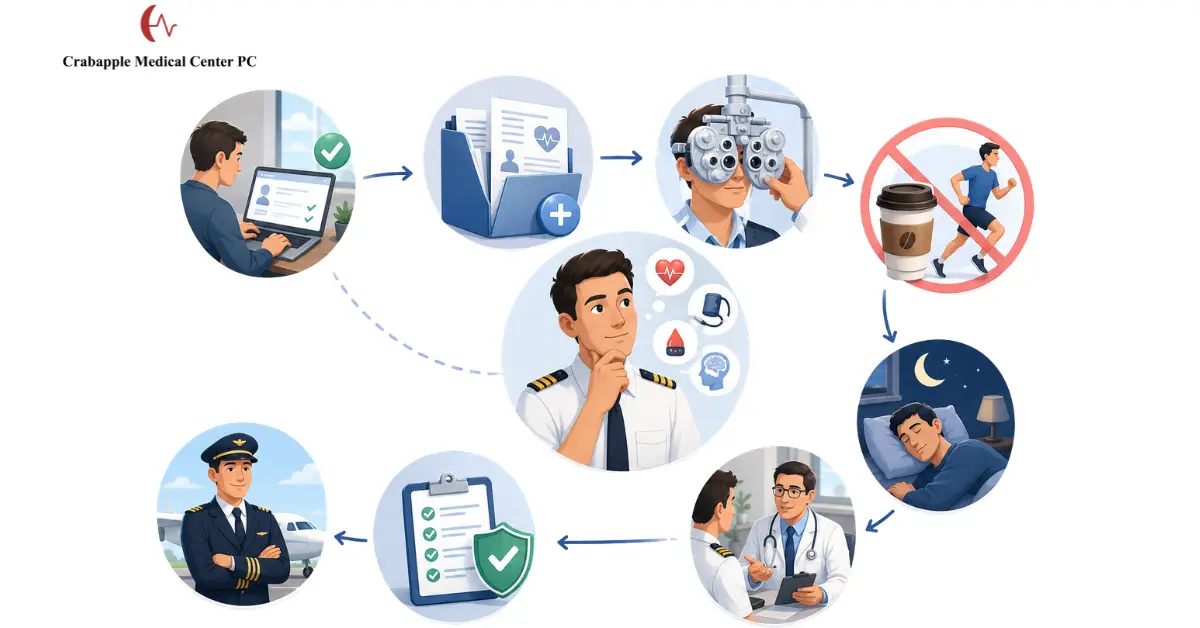
Proper preparation before your AME appointment can make a significant difference in how smoothly the exam goes. Here is what you should do ahead of time.
Complete Your MedXPress Application
The FAA requires all pilots applying for a traditional medical certificate to submit their medical history online through the FAA MedXPress system before their appointment. You will receive an application confirmation code, which you must bring to your exam. The AME cannot begin the examination without this number. Log in at medxpress.faa.gov and complete FAA Form 8500-8 honestly and thoroughly.
Accuracy on this form is critical. The FAA has access to a wide range of federal health databases, and any discrepancy between what you report and what appears in your medical records can create significantly more problems than simply disclosing a condition upfront. If you have questions about what to report, speak with your AME in advance.
Gather Your Medical Records
If you have any medical conditions, past surgeries, hospitalizations, or ongoing treatments, bring documentation. This includes records from your cardiologist, neurologist, or any specialist you see regularly. If you take prescription medications, bring a current list with dosages. The AME may need to review these to determine whether your condition or treatment is compatible with FAA medical standards.
Prepare Your Glasses or Contact Lenses
If you use corrective lenses, wear them or bring them to the appointment. The AME will test your vision with and without correction. Bring any prescription eyewear you use during flight operations.
Avoid Caffeine and Strenuous Activity
In the hours before your exam, avoid heavy caffeine consumption, which can elevate your blood pressure temporarily. Avoid strenuous exercise the morning of your appointment for the same reason. A resting blood pressure that falls just above the acceptable limit due to pre-exam stimulation can complicate your certification unnecessarily.
Get a Good Night's Rest
Fatigue affects eye performance, cognitive responses, and blood pressure. Arriving rested is a simple and effective way to present your best physical state.
What Happens During the FAA Aviation Medical Exam
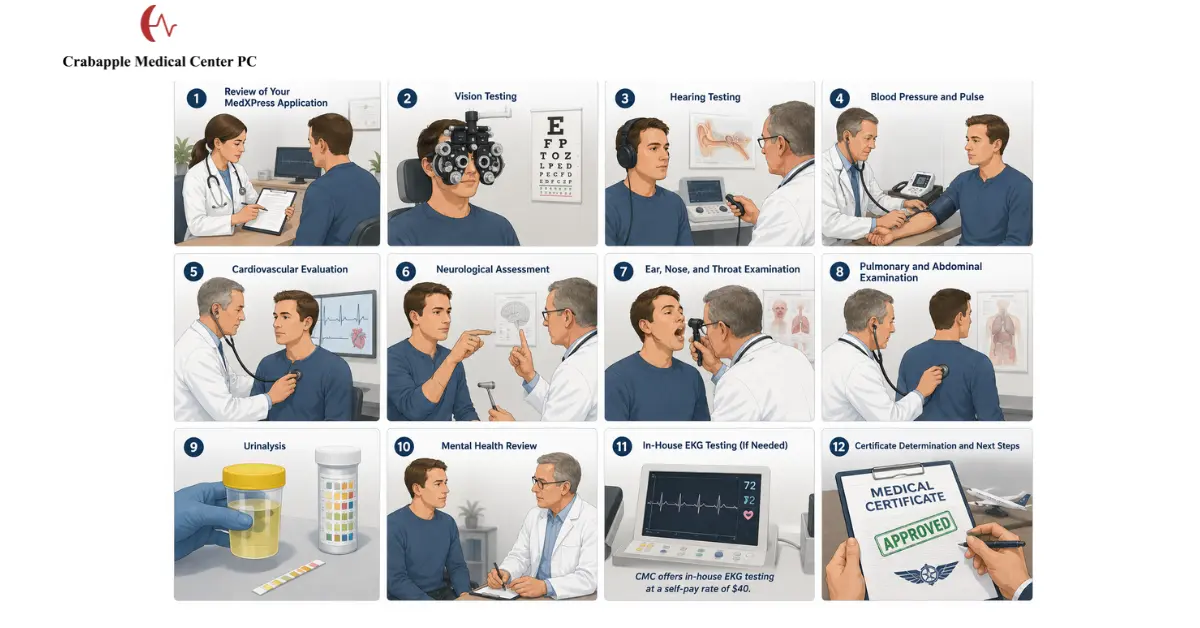
The exam itself is thorough but typically takes under an hour for most applicants with no complex medical history. Here is what you can expect at each stage.
Review of Your MedXPress Application
The examiner will begin by reviewing the information you submitted through MedXPress. This includes your full medical history, any conditions you have reported, medications you are currently taking, and any prior FAA medical actions such as previous denials or special issuances. Be prepared to discuss anything you listed and to answer follow-up questions.
Vision Testing
Vision is one of the most important components of any FAA physical. The AME will test your distant vision, near vision, and in some cases intermediate vision. The specific standards vary by certificate class.
For a Class 2 certificate, you must demonstrate distant visual acuity of at least 20/20 in each eye, with or without correction. Near vision must be at least 20/40. For a Class 3 certificate, the distant vision standard is 20/40 in each eye, with or without correction, and near vision must also be at least 20/40. Corrective lenses are permitted as long as they are available during flight.
Color vision is also evaluated. The ability to perceive the colors necessary for safe performance of flight duties is required. If you fail the standard color vision test, you may be eligible for an Alternative Color Vision Test or may be restricted to daytime flight operations only.
Hearing Testing
The AME will perform a hearing evaluation. At a minimum, you must be able to hear an average conversational voice in a quiet room from at least six feet away, with your back to the examiner. If there is any doubt, a formal audiometric test may be conducted. Hearing aids are permitted for Third Class certification in some cases and your AME can advise based on your specific situation.
Blood Pressure and Pulse
Your blood pressure and heart rate will be measured. The FAA requires that blood pressure not exceed 155 over 95 millimeters of mercury at the time of examination. If your reading is elevated, the AME may take multiple readings and allow you to rest before retesting. Pilots with controlled hypertension who are taking approved medications may still qualify, depending on the medication and how well the condition is managed.
Cardiovascular Evaluation
The AME will listen to your heart and assess for any abnormal sounds, rhythms, or signs of cardiovascular disease. For pilots with a history of heart conditions, documentation from a cardiologist and possibly an EKG or stress test may be required. CMC offers in-house EKG testing at a self-pay rate of $40, making it convenient to have this completed at the same visit if needed.
Neurological Assessment
The examiner will conduct a basic neurological evaluation to assess coordination, reflexes, and cognitive function. Any history of seizures, stroke, head injuries, or loss of consciousness will be explored in depth. These are areas the FAA takes very seriously given the direct impact they can have on flight safety.
Ear, Nose, and Throat Examination
The AME will examine your ears, nasal passages, and throat. Conditions such as ear disease, vestibular disorders, or severe sinusitis that could affect your ability to operate safely in pressurized or altitude-variable environments may be flagged during this portion.
Pulmonary and Abdominal Examination
The examiner will listen to your lungs and assess your abdomen for any abnormalities. Conditions such as asthma may require additional documentation but do not automatically disqualify a pilot. Controlled, well-documented asthma can be compatible with medical certification.
Urinalysis
A urine sample is typically required. The AME will test for glucose and protein, which can indicate diabetes or kidney issues. The presence of glucose in the urine may trigger additional evaluation.
Mental Health Review
The AME will ask questions related to your mental health history, including any treatment for anxiety, depression, or other psychological conditions. The FAA has become more nuanced in its approach to mental health in recent years, and many treated conditions are now compatible with medical certification. Honesty is essential here. Pilots who attempt to conceal mental health treatment and are later discovered risk far greater consequences than those who disclose and work through the proper channels.
Book Your FAA Flight Physical in Alpharetta
Do not let it lapse or let uncertainty about the process hold you back from scheduling. Crabapple Medical Center offers Class 2 and Class 3 FAA physicals as well as BasicMed evaluations with transparent, upfront pricing and no surprises.
Conditions That May Require Special Issuance

Certain medical conditions are considered disqualifying under FAA standards but may be eligible for a Special Issuance Authorization, which allows a pilot to fly despite the condition under specific monitoring requirements. Common examples include controlled hypertension, treated depression, type 2 diabetes managed without insulin, and a history of cardiac procedures.
If you have a condition in this category, it is important to work with an AME who is experienced in the special issuance process. Crabapple Medical Center's team can help guide you through what documentation is needed and how to submit your case to the FAA for review.
After the Exam: What Happens Next
If you meet all the standards for your certificate class, the AME will typically issue your medical certificate on the spot. You will receive a paper certificate that serves as your authorization to exercise pilot privileges.
If the AME identifies a concern that requires additional information or review, your application may be deferred to the FAA's Aerospace Medical Certification Division for further evaluation. This does not mean you have been denied. It means additional review is needed before a decision can be made. The AME will explain what documentation the FAA requires and how to submit it.
If a condition is found that is disqualifying and does not qualify for special issuance, the AME will advise you of your options, which may include appealing the decision or pursuing BasicMed if you are eligible.
BasicMed as an Alternative

For private pilots who hold or have previously held an FAA medical certificate and wish to avoid the traditional certification process, BasicMed offers a practical and less restrictive alternative. Under BasicMed, you may fly with a valid U.S. driver's license as a medical eligibility benchmark, as long as you have had a comprehensive physical exam with a state-licensed physician within the past 48 months and completed the AOPA online medical self-assessment course within the past 24 months.
Crabapple Medical Center conducts BasicMed evaluations and completes the required CMEC documentation. It is a straightforward visit and the pricing is clearly listed at crabapplemc.com/self-pay-prices. For pilots who fly recreationally and do not need the privileges that come with a traditional FAA certificate, BasicMed is worth serious consideration.
Why Choose Crabapple Medical Center for Your FAA Physical in Alpharetta
Crabapple Medical Center combines FAA certification with the warm, patient-centered care the practice is known for. Located at 282 Rucker Road, Suite 140 in Alpharetta, CMC is conveniently positioned for pilots across North Fulton County, Cherokee County, and the broader North Atlanta region.
CMC offers Class 2 and Class 3 FAA physicals as well as BasicMed evaluations, all at transparent self-pay pricing. The practice also provides in-house EKG testing, lab work, and urinalysis, so pilots can complete multiple components of their medical evaluation in a single visit without coordinating across multiple facilities.
Everything You Need in One Visit
At Crabapple Medical Center, pilots can complete their FAA medical exam, EKG, urinalysis, and necessary lab work all in a single appointment. No referrals, no extra trips across town. Our self-pay pricing is listed openly at crabapplemc.com/self-pay-prices so you know exactly what to expect before you arrive.
Frequently Asked Questions
What is an Aviation Medical Examiner and how is one different from a regular doctor?
An Aviation Medical Examiner is a physician who has been designated by the FAA to perform medical certification examinations for pilots. Unlike a regular physician, an AME is specifically trained in FAA medical standards and has the authority to issue medical certificates on the spot. Not every doctor can perform an official FAA flight physical; it must be done through a designated AME.
How do I apply for an FAA medical certificate before my appointment?
You must complete FAA Form 8500-8 through the online MedXPress system at medxpress.faa.gov before your appointment. Once you submit the form, you will receive a confirmation number that you bring to your AME visit. The examiner cannot begin your exam without this number.
How long does an FAA aviation medical exam take?
For most pilots with a straightforward medical history, the exam takes between 30 and 60 minutes. If you have conditions that require additional review or if the AME needs to request more documentation, the visit may take longer or require a follow-up submission to the FAA.
Can I still get certified if I take prescription medications?
Many prescription medications are compatible with FAA medical certification. The key factors are the condition being treated, how well it is controlled, and whether the specific medication is on the FAA's approved list. Always disclose all medications on your MedXPress application and bring documentation from your prescribing physician to your exam.
Does Crabapple Medical Center offer First Class FAA physicals?
Crabapple Medical Center currently offers Class 2 and Class 3 FAA flight physicals as well as BasicMed evaluations. Pilots who require a First Class medical certificate should call the office at 770-360-9484 to discuss current service availability.